Boundaries, Part III: Limiting the Discomfort
Last Boundary post (for now)...

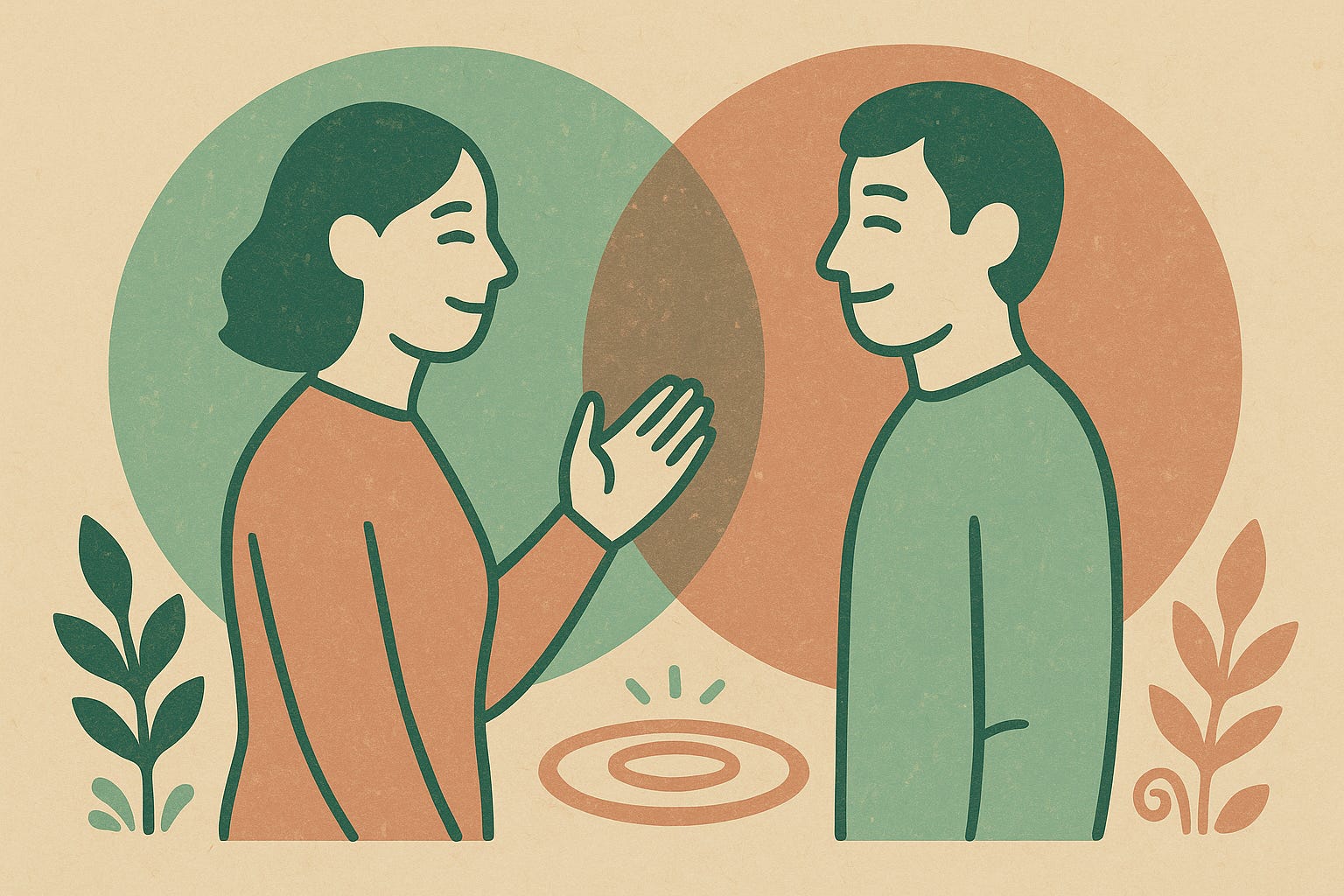
If you’ve been following along, you know we’ve been talking about boundaries and how a SELF centred approach makes boundaries more apparent.
Still, even when you have a good understanding of your boundaries, there’s often a lingering hesitation. That nervous, awkward feeling that bubbles up right before you say “no thanks.” The voice that whispers: Am I sounding mean? Am I doing something to them?
That’s the discomfort. And it’s exactly where most people get stuck.
Why Boundaries Feel Uncomfortable
We were taught early on that being “good” means being agreeable. We learned that keeping the peace often mattered more than expressing ourselves accurately.
So when it comes time to setting a boundary, our nervous system can confuse it with rejection or conflict. That’s why even a sentence like; “I can’t do that right now”, can feel like you’re breaking some sacred code.
It isn’t selfish and it certainly isn’t rejection. But it feels like it, because that’s the script we’ve hardwired into our central nervous system.
The Shift: From Confrontation to Kindness
Here’s where 360° Kindness is worth its weight.
A boundary doesn’t have to sound confrontational. It doesn’t have to be defensive. A kind boundary clearly says:
I won’t abandon myself.
I want what I give to you to be real, not resentful.
There is no confrontation or rejection in either of those points of understanding.
The discomfort begins to calm the moment you realize: a boundary isn’t something you do to someone else—it’s something you do for both of you.
Why Discomfort Melts Away in short order
Fear grows when we think boundaries are about defending ourselves or changing another person’s behaviour toward us. If you aren’t new here, you’ve seen me write “We are never more vulnerable than when we put our energy into things we cannot control” many times. And, respectfully, get used to it because its tattooed on the inside of my eyelids.
But boundaries aren’t about anyone else. They’re about you.
I admit, its a little scary re-evaluating our relationship with ourselves. It has often surprised me how many people are unsure what having a relationship with themselves even means. But you know what kindness feels like. You also (with few exceptions) know what its like to be happy
When being kind to yourself leads to a happier internal environment, that’s not selfishness, it’s freedom.
Small Practices That Change Everything
So how do you take the discomfort out of the process? By practicing kindness as you set the boundary.
Try this:
Pause before saying yes. If you are unsure, say “ Thanks for asking, I’ll get back to you on that.” Ask yourself: Will doing this be fulfilling and do I have time to give to it, or am I betraying myself?
Use simple, honest language. You don’t need a speech. “ Thanks, but that doesn’t work for me.” Or, “Thanks, but I can’t this week.”
Notice your nervous system. Boundaries set early feel calmer. Boundaries set late feel stressful. The more you practice early, the less discomfort builds.
Every small act like this builds trust with yourself. You begin to believe you won’t abandon your own needs. And with that trust, the fear of setting a boundary begins to dissolve.
Boundaries as Connection
It may sound paradoxical, but boundaries aren’t about separation. They make real connection possible.
When you stop pretending, when you stop saying “yes” with hidden resentment, you make room for authenticity. Relationships become more solid, more predictable.
That’s how discomfort fades over time: you’re no longer doing something to them. You’re staying in alignment with yourself.
Finally (for now)
This is why the mantra: you can’t be kinder to others than you are to yourself is fundamental.
When you realize boundaries aren’t selfish, aren’t rude, and aren’t about rejection, the nervousness begins to accept its fate. What’s left is a calm inner-core that does not need to scan the horizon for danger.
Until next week,
Mark
“We were taught early on that being “good” means being agreeable. We learned that keeping the peace often mattered more than expressing ourselves accurately.”
Perfectly said! I’ve had difficulty setting boundaries my whole life. I have finally set boundaries in the last few years or so. In the past, there were negative repercussions (abuse, etc.) for setting boundaries, so it’s been a tough road emotionally.
Thank you for your tips. They are great!
The discomfort begins to calm the moment you realize: a boundary isn’t something you do to someone else—it’s something you do for both of you." This quote perfectly encapsulates the core of your message, Mark. It's a powerful reminder that boundaries are not about creating distance, but about fostering healthier, more respectful relationships built on authenticity. This really resonates with me, as I've found that the moments I've been most upfront about my needs have actually strengthened my connections, rather than weakened them. It’s like when you’re truly honest about what you can and can’t offer, people appreciate the clarity, and it removes the guesswork and unspoken expectations that can often lead to friction.